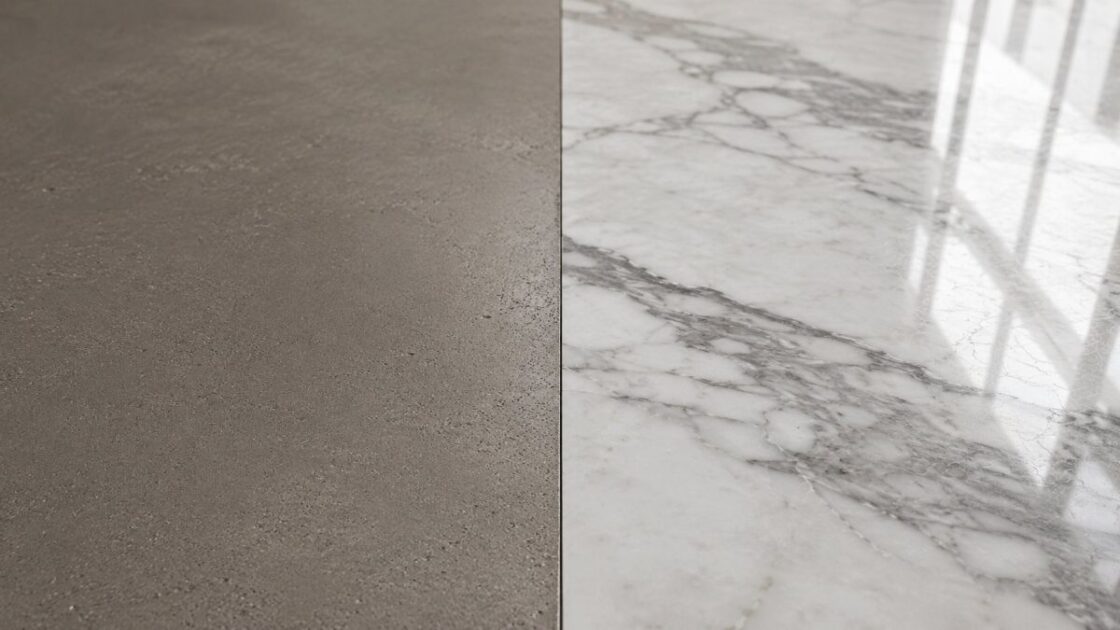
The floor sets the tone of an interior. Before aesthetics, one must consider use, light, maintenance and coherence with the architecture of the place.
Polished concrete: continuity
Seamless, it enlarges the space and catches the Mediterranean light. It demands impeccable execution — substrate, primer, successive coats, protection — on pain of cracking. Its strength: a living material, bespoke in its tone.
The word “concrete” misleads. This is not a slab but a coating a few millimetres thick, whose whole durability depends on what lies beneath. A substrate that moves cracks the finish, and a crack in polished concrete is not repaired: it is started again. So before discussing tone, we discuss flatness, residual moisture in the substrate and the treatment of movement joints. That is the part of the work no one will ever see, and it is the part that decides.
Marble: nobility
Carrara, Calacatta, Burgundy stone: marble crosses the centuries. Vein matching, setting out, honed or polished finish: the result depends entirely on the hand that lays it.
A successful laying is judged on three things. Setting out first: the position of the cuts, decided on the drawing and not as laying proceeds, so that thresholds, door axes and patterns fall right. Vein matching next: slabs cut from the same block are laid in the order in which they were sawn, book-matched or run-matched, so that the figure crosses the room. Calibration last: on solid stone, a millimetre of unevenness reads against the light, and the raking light of a bay opening onto the sea forgives nothing.
The right material is not the most expensive: it is the one that serves the place, and the right gesture.
What the place imposes before taste
On the coast, the material does not choose alone. Less than five hundred metres from the shore, the atmosphere falls within corrosivity categories C4 to C5 of the ISO 9223 standard: what the salt attacks is not the stone but the ironmongery, the threshold profiles, the fixings and the hardware. A flawless marble threshold set on unsuitable screws will stain with rust runs within two winters. Right on the sea, the A4 / 316L grade with molybdenum is required where an A2 / 304 grade would pit.
Available thickness often settles the debate before we do. In a Monaco apartment, every centimetre taken by a screed is paid for in ceiling height, and on a full-floor apartment that height is the very value of the property. Polished concrete, laid a few millimetres thick over an existing substrate, has an argument there that solid stone does not. Conversely, in a Cap-Ferrat villa where the floor is being rebuilt anyway, the constraint disappears and the debate becomes one of material again.
The register of the place counts just as much. The decorative vocabulary of the peninsula’s Belle Époque villas combines marble, staff and stucco, wrought ironwork and small-paned joinery: laying a continuous contemporary floor there is a decision of architecture, not a detail of finish. In Saint-Paul-de-Vence, the register is that of the Provençal hinterland — local stone, lime renders, timber framing and tiles — and the same material does not produce the same effect. In Èze-Village, the register is exposed stone, thin renders and vaults.
Maintenance, which is decided before laying
Both materials require protection, and they are two different protections. Polished concrete lives beneath its film: the film takes the stains, the film wears at the traffic lines, the film is renewed. Marble is a limestone: it fears acid far more than scratching. Lemon juice on a Calacatta kitchen top leaves a matt mark that only polishing recovers.
Hence a rule we set early, while it is still only a line on a drawing: the choice of a finish — honed, polished, brushed — is not merely aesthetic, it fixes the way the room will age and what the client will have to do about it. A honed finish hides use; a polished finish shows it. Neither is better; they do not address the same use, nor the same client.
Marrying the two, without a bastard transition
Our advice: reserve marble for reception rooms and bathrooms, polished concrete for continuous living spaces — and, often, marry the two with transitions drawn to the millimetre.
A transition between two floors is a piece of work in its own right. It is placed where the architecture justifies it — a threshold, a change of volume, the axis of a bay — and never where the laying happened to stop. It is drawn at the same time as both setting-out plans, not afterwards. Successful, it goes unnoticed; failed, it is the first thing the eye finds on entering the room.

