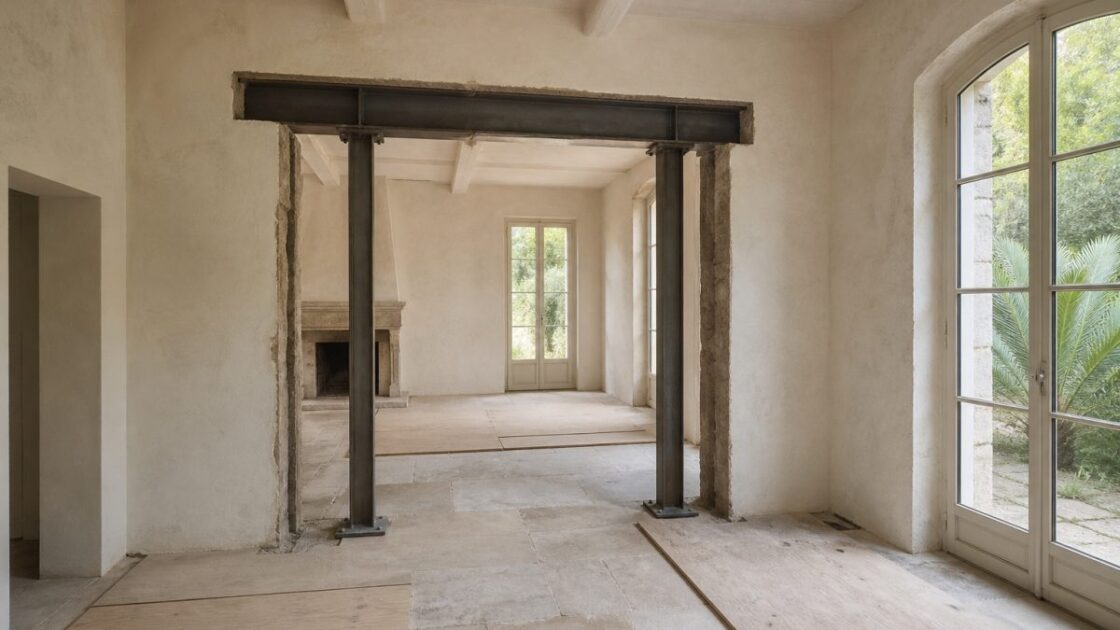
Opening a load-bearing wall transforms a volume, but it also changes the route by which the building carries its loads to the ground. The visible width is therefore only part of the subject. Before any removal, we must understand what the wall supports, where the forces will be transferred and what the opening will change in the adjoining rooms.
Read the structure before drawing the opening
Existing drawings provide a first indication, never enough certainty on their own. Wall thickness, material, floor direction, available bearings and previous alterations must be surveyed or probed. On structural work, this phase separates an architectural intention from a solution that can actually be built.
The administrative context is checked at the same time. In a condominium, its rules, the managing agent and the required approvals govern the intervention. In a private residence, a facade alteration or protected building may add further procedures. Calculations and approvals must be settled before the site puts a room out of use.
A written execution sequence
Temporary propping, removal zones, installation of the load transfer and inspection of the bearings form a single sequence. It is defined by the structural study and adapted to discoveries in the fabric. We also prepare access, lifting and removal: a correctly calculated beam remains a problem if it cannot enter or be handled without exposing the residence.
In structural work, the elegance of the result first depends on the precision of what will disappear.
Design the finish before the reinforcement
An opening often displaces services, changes a ceiling and reveals level differences. Finished thicknesses, downstands, floor junctions and light must be drawn before the reinforcement is ordered. This is how prestige renovation absorbs the technical work instead of displaying it.
In Monaco as elsewhere, we never promise an opening on the strength of a photograph alone. A visit, surveys and, when the project requires it, a structural engineer provide a grounded answer. It is less spectacular than the first swing of a sledgehammer. It is what protects the work.

