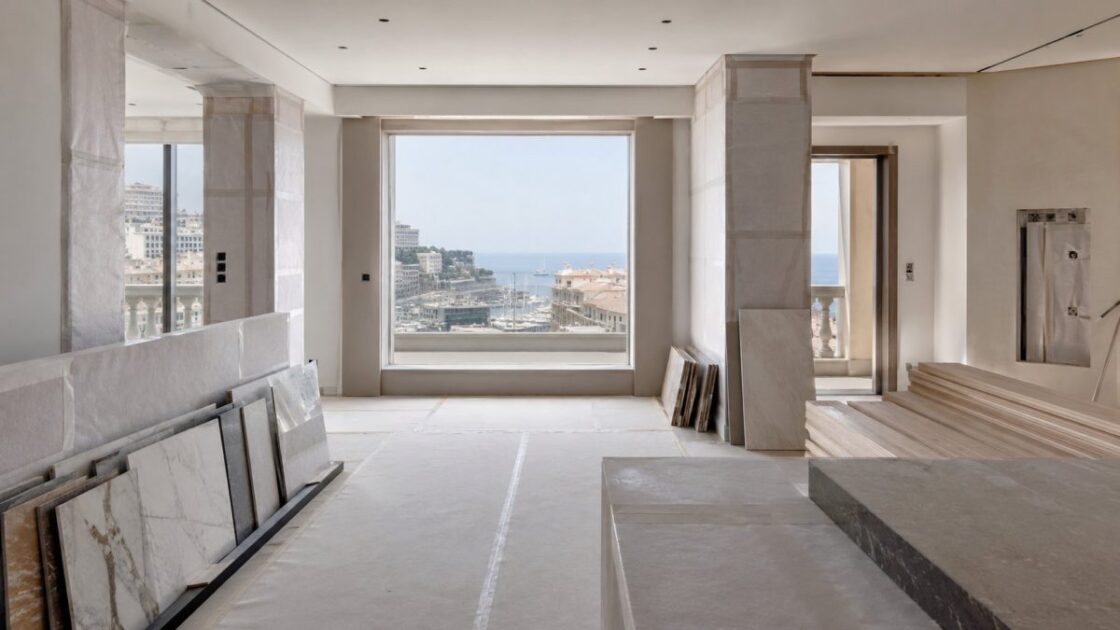
In the Principality, a prestige site contends with a strict building regulation, permanent neighbours and scarce access. Discretion is not an option: it is a specification.
A regime of its own, which is not French law
This is the point one understands first or pays for later. In Monaco, urban planning, construction and roads are governed by Sovereign Ordinance no. 3.647 of 9 September 1966, as amended, supplemented by Sovereign Ordinance no. 4.482 of 13 September 2013 for the ordered quarters. The application for authorisation to build or demolish must be signed by an architect registered with the Order of Architects of the Principality of Monaco, and it is examined by the Directorate of Forward Planning, Urban Development and Mobility.
Applications are reviewed by an advisory committee, which rules with regard to laws and regulations, to the aesthetic conditions of the proposed work, to the general interest and to its standing in the light of the history of Monaco. In other words, the assessment does not bear on technical compliance alone. The corollary to remember: the French planning code, the Coastal Act and the French regime governing the surroundings of historic monuments do not apply on the territory of the Principality. Reasoning read on a French site, or a habit formed in Nice, does not transpose here — and that holds for the vocabulary itself.
A second level of constraint is added, distinct from the administrative authorisation and often underestimated: the building regulation and the managing agent. Hours, protection of common areas, booking of access — these decide the real rhythm of the day. An authorised file and an unprepared building make for a site at a standstill.
Logistics to the millimetre
Regulated hours, a reserved site lift, protection of common areas, planned removal of rubble: every flow is anticipated so as never to disturb the life of the building.
The reason is geographical. The territory covers about two square kilometres, entirely built up: there is practically no surface available for site accommodation, material storage or a turning area. Nor is any mineral resource worked there — all materials, including stone and marble, arrive by road and pass through a street network that is narrow, steeply graded and largely doubled by underground structures. So nothing is stored: deliveries come as needed, in slots, and a phasing plan is judged first on its ability to hold without a stock on site.
Supplies for a site on an upper floor pass through the building’s common circulations — lift, goods lift, stairwells — which remain those of the residents. These are works to be protected before they are passages to be used: a landing marble scratched during a job is damage done to third parties who asked for nothing, and it is rarely repaired identically.
Silence as a signature
Low-nuisance tools, acoustic partitions, fine coordination of trades: noise is treated as a material to master. The neighbourhood must forget a site is under way.
This is not merely an elegance: it is regulated. Two ministerial orders published in the Journal de Monaco in December 2018 govern site noise and site hours, with the stated purpose of quality of life in the Principality. The work therefore consists in fitting the noisy tasks — demolition, drilling, structural repairs — into a short window, and reserving the rest of the time for silent work. It is a scheduling constraint before it is a tooling one.
An occupied building, on all its faces
Residential density makes the question of neighbours permanent: a Monaco site is surrounded by occupied dwellings on all its faces, above and below included. To this is added the state of the stock — a significant share of the buildings was built in the 1970s and 1980s, and their acoustic performance falls below present expectations. Hammer drilling in such a building is not heard only next door: it is heard three floors up. From this we draw a simple rule, with nothing commercial about it — warn beforehand rather than apologise afterwards.
What the salt imposes on exposed work
On seafront buildings — Larvotto, Fontvieille, the port — corrosion of reinforcement steel and of window hardware is the recurrent disorder: the atmosphere there falls within corrosivity categories C4 to C5 of the ISO 9223 standard. Repairing a balustrade, a window or a terrace without regard to the grade of the steel is a repair to be done again. The A4 / 316L grade, alloyed with molybdenum, resists appreciably better than an A2 / 304 grade. Indoors, the constraint becomes dimensional: available thicknesses command everything, and every centimetre taken by a screed, a lining or a suspended ceiling is paid for in ceiling height.
True luxury, in Monaco, is a site no one notices.

