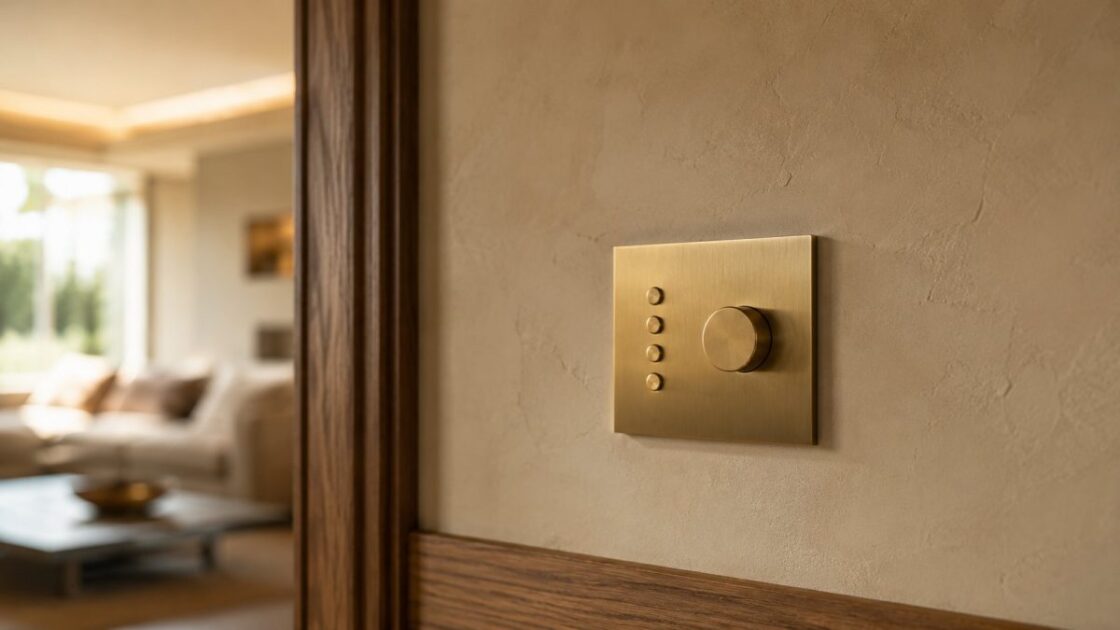
Home automation long rhymed with screens, multiplied switches and visible boxes. In a high-end renovation it is the opposite: technology must disappear, leaving stone, wood and light in the foreground.
Thinking the networks before the walls
Everything is settled at the structural stage: cable routes, power supplies, positions of sources and sensors are drawn well before the finishes. Successful home automation is decided on the drawing, not after the fact.
In practice this means laying conduits where nothing is yet needed, and leaving provisions where one is not certain. An empty conduit costs what it costs while the partition is open; the same route taken up again after renders, floors and joinery have been fitted becomes another job entirely. It is the only rule that truly counts in this field: what is easy before the walls are closed is difficult afterwards, and what is difficult afterwards is often visible.
The finest installation is the one whose very existence is forgotten.
What the available thickness allows
In an apartment, thickness is the material constraint number one. Every centimetre taken by a screed, a lining or a suspended ceiling is paid for in ceiling height — and on a full-floor Monaco apartment, that height is the very value of the property. Fitting an air-conditioning duct, a control network and a lighting plenum into what remains means drawing all three together, in section, before anything is poured.
In an old building the constraint changes in nature: one does not chase into a decor. The staff and moulded plaster of Nice’s bourgeois apartment buildings are the first work lost in the successive renovations of a flat, and restoring them requires a survey before removal — never a reconstruction afterwards. A network crossing a moulded cornice destroys in one morning what no one will know how to remake identically.
Effacement in the service of use
Lighting scenes on invisible dimmers, air conditioning integrated into staff cornices, flush loudspeakers, controlled blinds and shutters, discreet security and video: every function is there, without ever imposing itself on the eye.
Effacement applies to the controls as well. A wall of switches at the entrance to a living room is a confession: that of an installation one has failed to reduce. We prefer few control points, placed where the hand looks for them, and short scenes — one gesture, one result. Whatever is driven from a telephone must also be driven from the wall, because a guest does not download an application to light a room, and because a system whose only interface is a screen becomes unusable the day the screen stops answering.
Acoustics, half of the comfort credited to the technology
Part of what is asked of home automation is in fact a matter of acoustics. The acoustic performance of buildings from the 1960-1980 period falls below present expectations, in a fabric where dwellings adjoin on all their faces — above and below included. No lighting scene compensates for a floor that transmits. So the source is treated: floor decoupling, linings on independent framing, the choice and mounting of technical equipment — whose units and ducts are themselves a source of noise in the dwelling they serve.
Choosing a system that will age
We favour open, durable systems that are simple to live with — one gesture, one result — over technological escalation. A home is kept for a long time; a proprietary protocol is not. The question to ask is not what the system can do today, but who will be able to take it over in ten years, with which parts, and whether replacing a module means reopening a wall or opening a cupboard door.
Outdoors, the question becomes frankly material. Less than five hundred metres from the shore, the atmosphere falls within corrosivity categories C4 to C5 of the ISO 9223 standard: motors for shutters, gates and pergolas, entry panels, garden floodlights and their fixings age at the rhythm of the salt, not at the rhythm of their datasheet. The A4 / 316L grade, alloyed with molybdenum, resists appreciably better than an A2 / 304 grade. It is a choice that cannot be seen on handover and that reads after five years.
For in an exceptional residence, true comfort is the comfort one forgets.

