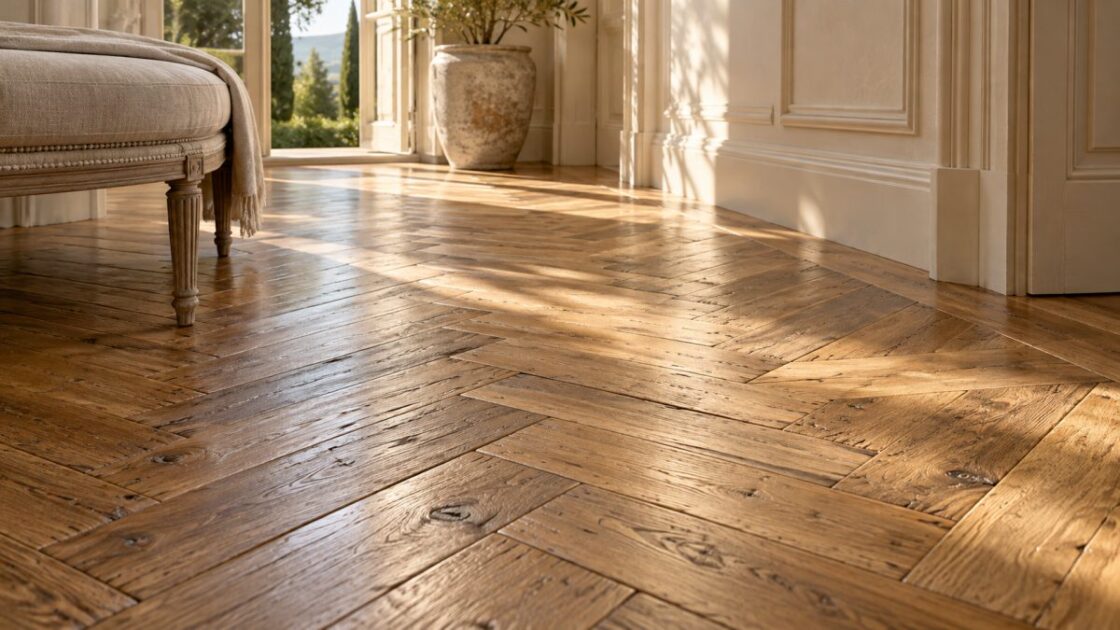
An old parquet floor lends a particular rhythm to a residence. Its pattern, nuances and marks tell of use that a new floor cannot reproduce exactly. Yet restoration requires more than a decision to sand it. We need to understand the type of floor, its condition and the interventions it has already undergone. The project distinguishes what can be retained, what needs repair and what the finish may recover. This assessment avoids treating a merely dulled surface in the same way as a floor where some boards are no longer properly secured.
Examine the floor beyond its appearance
Identifying the timber species, board construction and installation method comes before decorative choices. The professional checks loose areas, earlier repairs and the surroundings of water points. They also assess the material still available before considering abrasion. Within bespoke finishing work, preserving a floor therefore begins by understanding its limits. A dark colour alone does not reveal the condition of the timber. An irregularity or stain deserves to be understood before a general treatment is chosen to remove it.
Repair with respect for the existing pattern
A missing board involves its surroundings: dimensions, grain direction, pattern and junctions with neighbouring rooms. We locate repairs on a plan to assess their place in the whole. Replacement timber should be selected for compatibility with the existing work, then observed in the room’s conditions. A repair can remain slightly visible without detracting from the floor’s character. The aim is to recover coherent continuity, rather than arbitrarily erase every old variation until the parquet becomes a surface with no history.
Choose the most appropriate intervention
Depending on the floor and its current protection, maintenance, refinishing and complete sanding address different situations. The methods and products selected must be compatible with each other and with the substrate. In a residence in Nice, we recommend having the floor examined on site, then requesting a trial when the visual outcome remains uncertain. Manufacturers’ instructions guide preparation and application. We avoid prescribing a universal method: the right intervention depends on what the parquet can withstand and its intended use.
Approve the finish in the light of the room
Mattness, colour and texture change the presence of timber. A sample should be viewed beside the walls and other planned materials, first in natural light and then under the selected lighting. We consider future maintenance at the same time, since a finish is also chosen for the care it requires. In a prestige renovation, parquet relates to thresholds, skirting boards and doors. These junctions are designed before restoration, so that the restored surface is not subsequently affected by alterations that could have been anticipated.
Organise protection and the return to use
Parquet restoration belongs within a precise sequence of work. Interventions that might damage it are anticipated, and temporary protection is selected to suit the finish applied. Drying and return-to-use times vary between systems: the manufacturer’s guidance must be passed on, particularly for replacing rugs and furniture. We keep product references and maintenance advice with the residence’s records. The care given to this final stage sustains the restoration long after the craftspeople have left.

