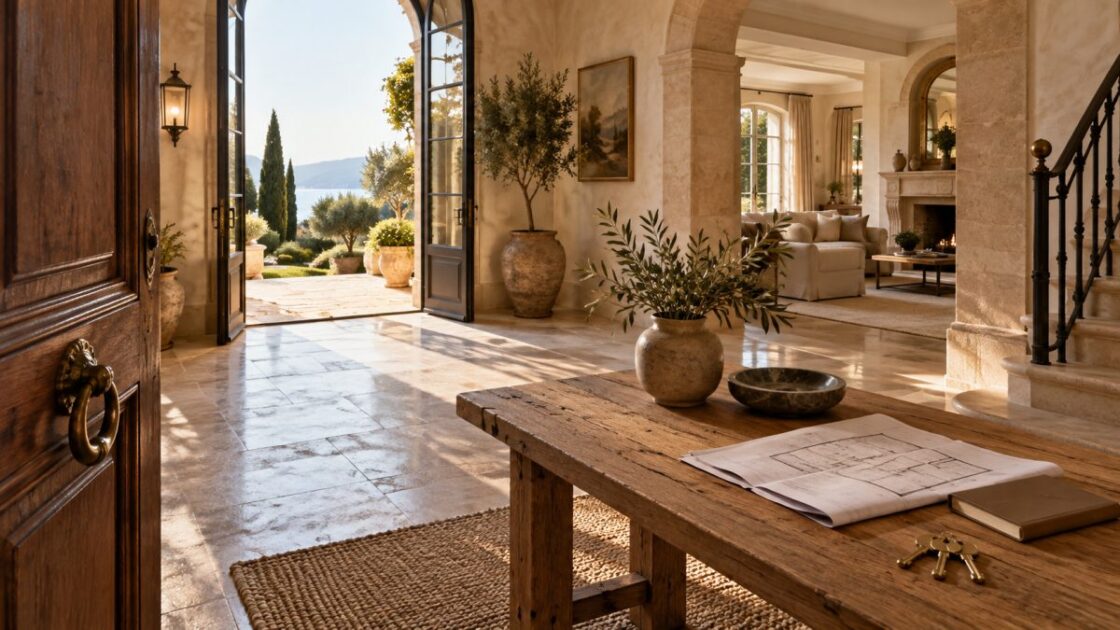
The first visit to a residence gives the project a direction. It brings your wishes into relation with the existing building, identifies initial constraints and prepares necessary checks. It does not reveal everything behind a covering or in an inaccessible area. We therefore prepare it as a time for observation and discussion, with an explicit place for unknowns. You do not need to arrive with a fully drawn project. A few documents and a precise description of how you live are often more useful than a collection of images unrelated to the place.
Gather the documents available
Plans, diagnostic reports, instructions and records of earlier work can help explain the residence. Their date and scope are identified, since an old plan may not include recent alterations. We recommend keeping documents in their original state and simply noting known differences. For a prestige renovation, these elements provide a working basis to be checked on site. They can also identify people to contact or studies to commission. Missing documents do not prevent the visit; their absence becomes information for organising the next steps.
Describe uses before solutions
We seek to understand what works and what causes difficulty in daily life. A cluttered entrance, a bedroom lacking privacy or a room that is difficult to furnish provide concrete information. Also describe future uses: entertaining more often, working from the residence or making certain movements easier. You can distinguish elements to retain from desired transformations. This description allows several possible responses. It helps avoid an early solution, such as removing a partition, obscuring the original need that the project should actually meet within the organisation of your life.
Allow the whole to be understood
Even when your request concerns a single room, its relationships with neighbouring spaces deserve observation. Access, levels and equipment provide reference points for the next stages. In a residence in Cannes, we also seek to understand delivery routes and ways to protect retained areas. Accessible areas are visited with your agreement; those that cannot be reached are recorded. No destructive investigation follows automatically from this visit. Further investigations are defined afterwards, explaining their purpose and scope before any intervention.
Report observations without interpreting them
A recurring mark, a door that has become difficult to close or an old repair are useful to know about. You can indicate when the phenomenon appears and whether it has changed, without trying to suggest its cause. We distinguish observation, hypothesis and a diagnosis still to be established. When a question concerns structural and major building work, examination by the competent specialist should precede any decision to intervene. A first visit also helps recognise these limits. Naming what remains to be checked gives the project a firmer basis than a quick explanation inferred from a single clue.
Leave with clear next steps
After the visit, the agreed needs, missing documents and checks to arrange can be gathered in a report. Next steps are linked to what needs deciding: a supplementary survey, a technical study, a layout option or a material choice. You should be able to understand why each stage is useful and what it will clarify. We recommend approving this basis before making detailed choices. The first meeting then fulfils its role: making the residence and your project sufficiently clear to proceed with precise questions and informed decisions. If the residence is not yet yours, the visit is prepared differently: we explain how in estimating renovation work before buying a villa.

